


The horizontal screw centrifuge mainly consists of a drum, a screw, a differential system, a liquid level baffle, a drive system and a control system, etc. It is a dedicated solid-liquid separation equipment designed in accordance with the characteristics of petroleum drilling fluid. It can complete various processes such as feeding, centrifugal sedimentation and unloading at full speed. It is mainly used for recovering barite, removing fine solids, reducing the solid content of drilling fluid, controlling the density and viscosity of drilling fluid, ensuring the performance of drilling fluid and playing an important role in rapid drilling. The LW series centrifuge separates drilling suspensions based on the principle of centrifugal sedimentation. The suspension enters the drum through the liquid outlet hole in the screw conveyor via the feed pipe. Under the action of centrifugal force, solid particles are pushed to the inner wall of the drum and discharged from the small end of the drum through the blades on the screw conveyor. The liquid phase overflows through the overflow hole at the large end of the drum. This cycle is repeated continuously to achieve the purpose of continuous separation. The sedimentation centrifuge belongs to the category of horizontal screw centrifuges, and its full name is horizontal screw sedimentation centrifuge.
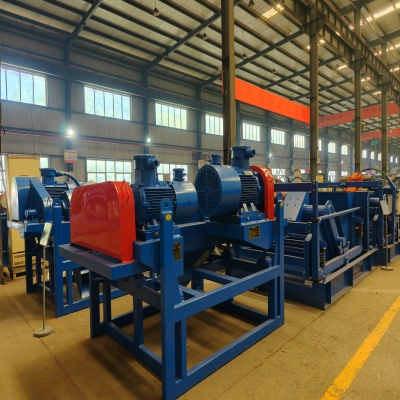
Factors affecting the performance of horizontal screw centrifuges
The application effect of the horizontal screw centrifuge is influenced by the mechanical part, which can be divided into adjustable factors and non-adjustable factors. The following is an explanation of each. First, by understanding its working principle, it can be effectively controlled during use
The non-adjustable mechanical factors include: the diameter of the drum and its effective length. Semi-cone Angle of the drum. Pitch. Spiral type. The following classification is explained: Drum diameter and effective length: The larger the drum diameter, the longer the effective length, the larger the effective settlement area, and the greater the processing capacity. The semi-cone Angle of the drum: When the sediment settled on the inner side of the centrifuge drum is pushed towards the discharge port along the conical end of the drum, it is subjected to a downward sliding reflux force due to the effect of centrifugal force. The semi-cone Angle of the drum: A relatively important parameter in the design of centrifuges. In terms of clarification effect, the cone Angle should be as large as possible. In terms of slag conveying and dewatering effects, the cone Angle should be as small as possible. Pitch: that is, the distance between two adjacent helical blades, is a very important structural parameter and directly affects the success or failure of slag transportation. When the diameter of the helix is constant, the larger the pitch and the greater the helix Angle, the greater the chance that the material will get clogged between the helix blades. At the same time, a large pitch will reduce the number of turns of the helical blade, resulting in uneven material distribution at the conical end of the drum and causing increased machine vibration. Therefore, for difficult-to-separate materials such as activated sludge, the conveying of the residue is rather challenging, and the pitch should be smaller. Spiral type: According to the different ways of relative movement of liquid and solid within the drum, it is divided into counter-flow type and co-flow type. The feeding chamber of the counter-flow centrifuge is located in the middle of the screw, that is, near the boundary between the drying zone and the sedimentation zone, to ensure that the liquid phase has sufficient sedimentation distance, but the solid phase can only stay for the time it needs to pass through the conical part, so a relatively high centrifugal force is required. When materials enter the drum from here, the solid particles that have already settled in this area will float up again due to disturbance, and turbulence and additional vortices will also be generated, reducing the separation effect.
2. Adjustable mechanical factors include:
drum speed, differential speed (differential ratio), liquid ring layer thickness, and process factors. The following is a classification explanation: Drum speed: The adjustment of drum speed is usually achieved through a variable frequency motor or a hydraulic motor. The greater the rotational speed, the greater the centrifugal force, which is conducive to increasing the solid content of the mud cake. However, if the rotational speed is too high, the sludge flocs will be destroyed, which will instead reduce the dewatering effect. At the same time, higher rotational speeds have higher requirements for materials, increase the wear and tear on the machine, and the power consumption, vibration and level will also increase accordingly. Differential velocity (differential ratio) directly affects the sludge discharge capacity, the dryness of the sludge cake and the quality of the filtrate. Increasing the differential velocity is beneficial for enhancing the sludge discharge capacity, but the dewatering time of the sediment will be shortened, and the moisture content of the sludge cake after dewatering will be high. At the same time, excessive differential velocity will increase the disturbance of the screw to the liquid pool in the clarification zone, and the quality of the filtrate will be relatively poor (commonly known as "backmixing"). The thickness of the liquid ring layer: The thickness of the liquid ring layer is an important parameter for equipment optimization, directly affecting the effective sedimentation volume of the centrifuge and the length of the drying zone (shore zone), and thereby influencing the treatment effect of sludge dewatering. Generally, it is achieved by manually adjusting the height of the liquid level baffles when the machine is shut down. During adjustment, it is necessary to ensure that the heights of all liquid level baffles are consistent; otherwise, it will cause severe vibration during the operation of the centrifuge. An increase in the thickness of the liquid ring layer will expand the sedimentation area, and the residence time of the material in the machine will also increase accordingly, improving the quality of the filtrate. However, at the same time, the length of the drying zone (shore zone) within the machine will shorten, resulting in a decrease in the dryness of the mud cake. On the contrary, reducing the thickness of the liquid ring layer can achieve a higher solid content in the mud cake, but it comes at the expense of the quality of the filtrate. Process factors: To improve the dewatering performance of sludge, an appropriate amount of organic high-molecular flocculants, such as polyacrylamide (PAM), should generally be uniformly added before mechanical dewatering to reduce the specific resistance of the sludge, making it easier to dewater after the separation of the solid and liquid phases of the sludge. The type of flocculant must be compatible with the characteristics of the sludge, as well as the type of equipment and operating conditions. In many cases, the reagents that perform well in the beaker test for flocculant selection do not have better performance in practical applications. A very important reason for this is that although the characteristics of the reagents to some extent meet the characteristics of the sludge, they cannot fully meet the operating conditions of the equipment.
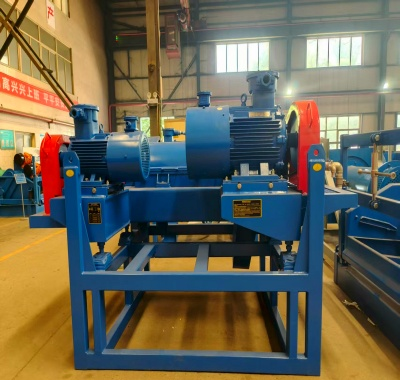
There are many factors that affect the dewatering efficiency of the horizontal screw centrifuge, and these factors interact with each other. Therefore, the treatment effect is the result of the combined action of the above-mentioned factors. The selection of the centrifuge should be based on the actual situation of the engineering project, and the adjustment of operating parameters should comprehensively consider factors such as the expected moisture content, solid content and economy of the dewatered mud cake as required by the disposal method of the dewatered mud cake.