


Drilling waste management now forms part of the overall drilling-fluid optimization strategy. Operators no longer treat drill cuttings and contaminated fluids only as waste streams for transportation and disposal. Instead, they emphasize early solids separation, fluid recovery, and onsite treatment. Several practical considerations drive this shift. These include the cost of drilling fluids, waste transportation, and disposal requirements. They also include the need to maintain efficient solids control throughout the drilling process. Modern drilling-waste systems therefore combine solids-control and waste-treatment technologies. This combination recovers usable fluid and reduces the volume of material that requires final disposal.
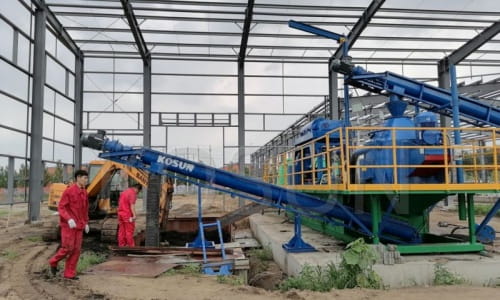
Why Drilling Fluid Recovery Starts at the Rig Site
Drilling returns contain a mixture of drilling fluid and drilled solids. If these components stay mixed throughout the waste-handling process, valuable drilling fluid leaves together with the solids.
Early mechanical separation recovers this fluid before the cuttings enter downstream waste-handling and disposal processes. For this reason, integrated systems combine shale shakers, cuttings dryers, and centrifuges within a broader solids-control and fluid-recovery strategy.
3-Stage Solids Control Configuration for Drilling Waste
Stage 1: Primary Solids Separation with a Shale Shaker
The shale shaker handles the first major solids-separation stage for drilling returns. It receives the returned drilling fluid and screens out coarse drilled solids. Removing these larger solids early reduces the solids loading on downstream equipment. It also keeps the separated drilling fluid within the active fluid-management system. That is a key objective of any drilling waste management program.
Stage 2: Residual Fluid Recovery with a Vertical Cuttings Dryer
The cuttings discharged from the shale shaker can still hold a significant amount of residual drilling fluid. A vertical cuttings dryer uses high-speed centrifugal force to separate liquid from the wet cuttings. Operators then collect the recovered fluid for further processing or reuse, depending on the drilling-fluid system and site configuration.
At the same time, the dryer produces drier solids. This reduces the liquid content and overall volume associated with downstream waste handling and disposal. Modern drilling waste management systems widely use vertical cuttings dryers for this purpose.
Stage 3: Fine-Solids Separation with a Decanter Centrifuge
In a complete drilling waste management configuration, fine-solids separation often follows primary solids removal and cuttings treatment. A decanter centrifuge separates fine suspended solids from drilling fluids and recovered liquid streams at high speed. This helps maintain fluid cleanliness, control low-gravity solids, and reduce the need for excessive dilution or replacement of drilling fluid.
The exact centrifuge configuration depends on the drilling-fluid type, solids loading, required separation performance, and overall process design. In more advanced systems, centrifuges may also work alongside additional treatment or fluid-conditioning steps.
From Waste Disposal to Drilling Fluid Recovery
An integrated drilling waste management system does more than remove solids. Its broader objective is to recover usable drilling fluid, reduce waste generation, and minimize the material that ultimately requires transportation and disposal.
Field applications have demonstrated the potential of integrated solids-control and cuttings-treatment technologies. They reduce fluid losses and disposal volumes. For example, one documented onshore application combined shale-shaker separation with a vertical cuttings dryer. It reduced mud losses by 40% and waste volume for disposal by 17%. In another application, an enhanced fluid-recycling system reduced waste fluid by 32% and lowered water and trucking requirements.
These examples illustrate the broader direction of drilling waste management. Recover more at the source, reduce what becomes waste, and optimize the remaining treatment and disposal process.
Engineering Integrated Separation Systems
For KOSUN, the focus goes beyond supplying individual pieces of equipment. We engineer equipment combinations according to the drilling fluid characteristics, solids loading, treatment capacity, and site conditions.
Depending on the application, shale shakers, vertical cuttings dryers, decanter centrifuges, conveyors, tanks, pumps, and control systems can form a modular drilling waste management configuration. The drilling-fluid system, expected solids characteristics, required fluid recovery, environmental requirements, and available site infrastructure determine the final process design.
Effective drilling waste management begins with separation at the source. It extends through recovery, treatment, and responsible waste handling.
FAQ
What is drilling waste management?
Drilling waste management separates, recovers, and treats drill cuttings and contaminated fluids. It reduces disposal volume and recovers usable drilling fluid.
How does a vertical cuttings dryer work?
A vertical cuttings dryer uses high-speed centrifugal force to separate residual drilling fluid from wet cuttings. It produces drier solids and recoverable liquid.
What is the role of a decanter centrifuge in drilling waste management?
A decanter centrifuge removes fine suspended solids from drilling fluids. This maintains fluid properties and reduces dilution requirements.
How much can fluid recovery reduce drilling waste?
Documented field applications show reductions of up to 40% in mud losses. They also show 17%–32% reductions in waste volume, depending on the separation configuration and site conditions.