


In the entire process of drilling mud treatment, the drilling fluid shale shaker, as the "first line of defense for purification", plays an irreplaceable and crucial role. As the core equipment at the very front end of the solid-phase control system, it can quickly remove a large amount of drill cuttings generated during the drilling process with its efficient solid-liquid separation capability, laying a solid foundation for the subsequent mud purification treatment and directly affecting the efficiency and economy of the drilling operation.
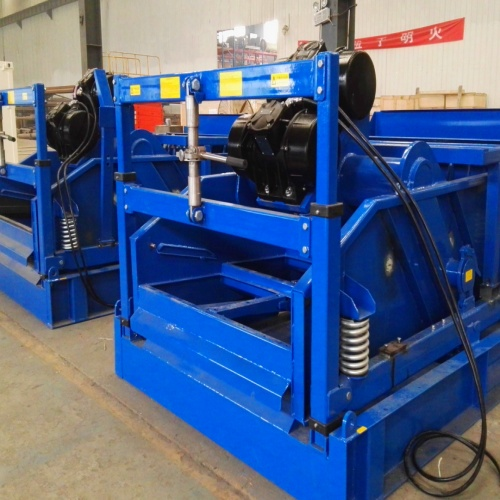
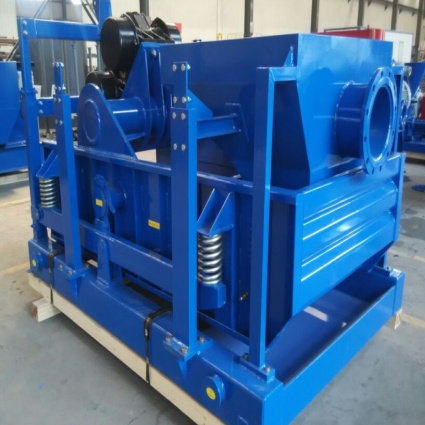
The working principle of the drilling fluid vibrating screen is based on the synergistic effect of mechanical vibration and screen filtration. The motor drives the exciter to rotate at high speed through a belt drive, generating a directional excitation force that drives the screen box to perform regular reciprocating vibration. When the mud carrying drill cuttings is evenly distributed on the screen surface from the slurry inlet, under the effect of vibration, the liquid phase and fine solid particles in the mud pass through the pores of the screen and enter the lower equipment, while the drill cuttings with a particle size larger than the screen holes are effectively discharged along the inclined direction of the screen surface and fall into the slag discharge trough to complete the separation. The mesh size and material selection of the screen should be flexibly adjusted according to the actual drilling geological conditions. In soft strata, 40-80 mesh screens are usually chosen to ensure processing capacity, while in hard rock strata, 100-200 mesh screens are used to improve separation accuracy.
Engineering practice shows that the separation efficiency of the drilling fluid vibrating screen directly determines the reuse rate of the mud. In deep well drilling operations, the comprehensive cost of one cubic meter of mud per cycle can reach 3,000 to 5,000 yuan. If the separation effect of the vibrating screen is poor, a large amount of drill cuttings remaining in the mud will lead to deterioration of rheological properties, not only significantly increasing the energy consumption of the mud pump, but also may cause complex downhole situations such as wellbore diameter reduction.
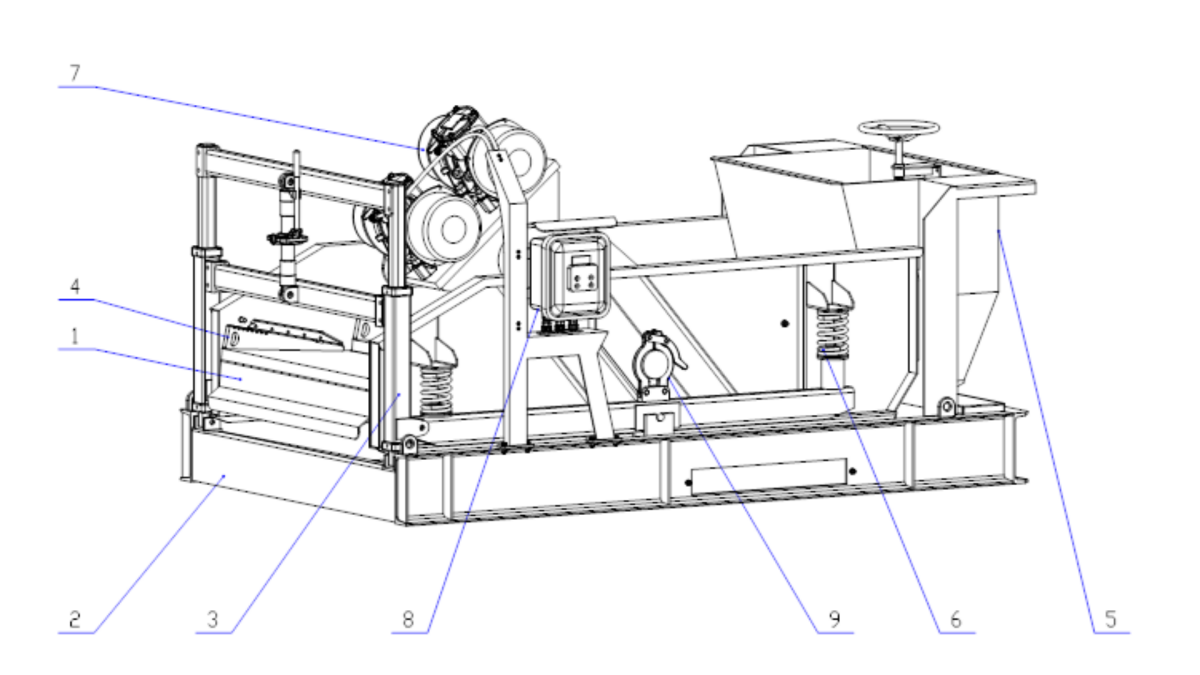
1. Sieve frame; 2. Base; 3.AWD Angle adjustment system; 4. Sieve tensioning system; 5. Feeding box; 6. Vibration isolation device; 7. Vibrating motor; 8. Electrical system; 9. Locking device
The coordinated cooperation between the drilling fluid vibrating screen and the subsequent solid control equipment is particularly crucial. When the mud that has been initially purified by the vibrating screen enters the secondary treatment equipment such as the desander and desilter, since the large drill cuttings have been effectively removed, these devices can focus more on dealing with fine particle impurities, avoiding the decline in treatment efficiency caused by screen blockage.
As the primary step in the purification of drilling mud, the stable and efficient operation of the drilling fluid vibrating screen is an important foundation for ensuring drilling safety and enhancing economic benefits. Its technological development has always been continuously advanced around the major direction of "efficient separation and energy conservation and environmental protection". In the future intelligent drilling system, this key equipment will continue to play an irreplaceable fundamental role, providing a solid guarantee for the safe and efficient implementation of drilling projects.