

Industry Update

Industry news, technical insights, and updates on solids control, mud treatment, and waste management.

Structural Characteristics of Decanter Centrifuge

Structural Characteristics of Decanter Centrifuge Decanter Centrifuge realizes solid-liquid separation mainly in the rotating drum. Rotary drum, auger, differential, etc. form a rotating assembly, which is supported by two main bearings, and the bearing seat is horizontally fixed on the machine base. The auger is concentrically placed in the drum through the angular contact bearing and the roller bearing. The auger is connected with the differential spline sleeve through the spline shaft. The main motor transmits power to the drum through the pulley. The auxiliary motor transmits power to the differential through the auxiliary pulley and is connected with the first-stage sun gear. 1) Drum: It consists of a cylindrical section and a conical section cylinder, and the right end is the big end

Structural Characteristics of Decanter Centrifuge Read More »

KOSUN Decanter Centrifuge Operating Rules

Decanter Centrifuge Operating Rules Ⅰ. Start 1.Turn on the power of the control cabinet, start the agitator, and start the screw conveyor. 2. The panel enters the language selection mode: Select English. 3.Frequency setting: Main motor: 25Hz Auxiliary motor: 25Hz The frequency of the feed pump motor and the dosing pump motor should be adjusted according to the separation effect. 4.Start the auxiliary motor: Start the main motor after the current and vibration are normal. 5.Start the main motor: Start the dosing pump after the current and vibration are normal. 6.Start the dosing pump, then start the liquid feeding pump 5 seconds later. (Frequency setting: 0-40Hz, adjust according to separation effect) 7.If there is any abnormality during startup, stop immediately for inspection. II. Shutd

KOSUN Decanter Centrifuge Operating Rules Read More »

Drilling Rig Mud Cleaner: Efficient Cleaning Equipment for Drilling Mud

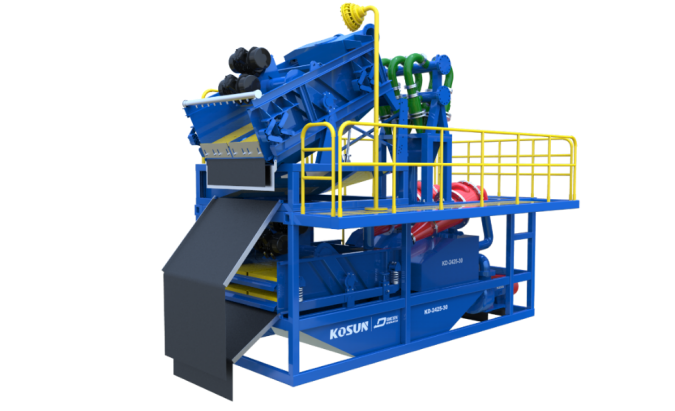
Drilling Rig Mud Cleaner: Efficient Cleaning Equipment for Drilling Mud Mud Cleaner is Integrated Sand and Mud Remover The mud cleaning machine is an integrated machine designed for removing sand and cleaning mud during drilling operations. As secondary and tertiary solids control equipment for drilling mud, it plays a vital role in maintaining the efficiency and effectiveness of the drilling process. The mud cleaner is equipped with a cyclone group with a combination of a high wear-resistant polyurethane desanding cyclone and a polyurethane cyclone. This configuration ensures thorough cleaning of the drilling mud, removing solid particles and impurities to maintain required mud properties. The mud cleaner design includes larger diameter overflow and feed tubes and smaller cone angles, inc

Drilling Rig Mud Cleaner: Efficient Cleaning Equipment for Drilling Mud Read More »

Drilling Fluid Mud Cleaner: Unraveling Its Characteristics and Diverse Applications in the Oil and Gas Industry

Drilling mud cleaners are an essential component of the solids control process in the oil and drilling industry. It plays a vital role in separating harmful solid particles of 15um and above from drilling fluid and ensuring the purification and efficiency of drilling fluid. The principles and application areas of a drilling mud cleaner is rooted in its design and functionality, making it an important tool in solids control system. The drilling mud cleaner mainly consists of a cleaner base, a screen box, an inclination adjustment mechanism, a bracket, a vibration motor, an explosion-proof controller, a desander, a desilter, a throttling manifold, etc. This comprehensive composition efficiently and effectively separates solid particles from drilling fluids. The mud desander is located after

Drilling Fluid Mud Cleaner: Unraveling Its Characteristics and Diverse Applications in the Oil and Gas Industry Read More »

Drilling Fluid Mud Cleaner: Unraveling Its Characteristics and Diverse Applications in the Oil and Gas Industry

Drilling mud cleaners are an essential component of the solids control process in the oil and drilling industry. It plays a vital role in separating harmful solid particles of 15um and above from drilling fluid and ensuring the purification and efficiency of drilling fluid. The principles and application areas of a drilling mud cleaner is rooted in its design and functionality, making it an important tool in solids control system. The drilling mud cleaner mainly consists of a cleaner base, a screen box, an inclination adjustment mechanism, a bracket, a vibration motor, an explosion-proof controller, a desander, a desilter, a throttling manifold, etc. This comprehensive composition efficiently and effectively separates solid particles from drilling fluids. The mud desander is located after

Drilling Fluid Mud Cleaner: Unraveling Its Characteristics and Diverse Applications in the Oil and Gas Industry Read More »

Drilling Fluid Mud Cleaner: Unraveling Its Characteristics and Diverse Applications in the Oil and Gas Industry

Drilling mud cleaners are an essential component of the solids control process in the oil and drilling industry. It plays a vital role in separating harmful solid particles of 15um and above from drilling fluid and ensuring the purification and efficiency of drilling fluid. The principles and application areas of a drilling mud cleaner is rooted in its design and functionality, making it an important tool in solids control system. The drilling mud cleaner mainly consists of a cleaner base, a screen box, an inclination adjustment mechanism, a bracket, a vibration motor, an explosion-proof controller, a desander, a desilter, a throttling manifold, etc. This comprehensive composition efficiently and effectively separates solid particles from drilling fluids. The mud desander is located after

Drilling Fluid Mud Cleaner: Unraveling Its Characteristics and Diverse Applications in the Oil and Gas Industry Read More »

Drilling Waste Treatment: Drilling Waste Harmless Treatment Technical Specifications Detailed

Definition of drilling waste: Drilling waste refers to the waste generated during drilling operations, including rock cuttings, drilling mud, chips, drilling fluid, cement slurry, etc. These waste materials contain various organic substances and heavy metals, which can cause significant harm to the environment and human health if not properly treated. Classification and harmless treatment technologies for drilling waste: According to the treatment methods, drilling waste can be classified into three types: physical treatment, chemical treatment, and biological treatment. Specifically, harmless treatment technologies include solidification, microbial treatment, compaction, leak control, etc. Specifications and precautions for harmless treatment technologies: The harmless treatment of drilli

Drilling Waste Treatment: Drilling Waste Harmless Treatment Technical Specifications Detailed Read More »

×

Get a Free Quote