


In drilling operations, drilling fluid does much more than carry cuttings back to the surface. It cools and lubricates the drilling assembly, maintains wellbore stability, and transports drilled solids out of the hole. Once that fluid returns to the surface, those solids must be removed before the mud continues through the treatment loop — and the first machine that does this job is the shale shaker.
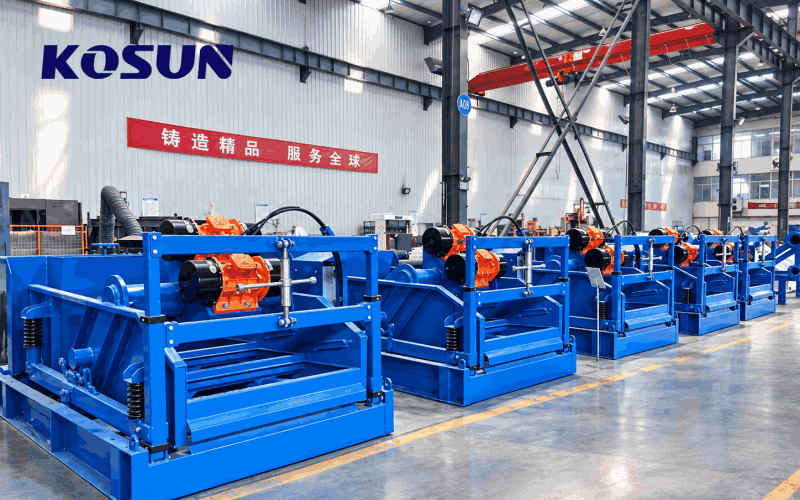
What Is a Shale Shaker in a Solids Control System?
A shale shaker is the first stage of solids control equipment on a drilling rig. Drilling fluid containing drilled cuttings flows across a vibrating screen. Solids larger than the screen openings stay on the deck and are conveyed toward the discharge end, while the liquid phase and finer particles pass through.
The principle is simple, but real performance depends on several interacting variables:
Drilling fluid properties — viscosity and density change how fluid passes through the screen.
Solids loading — the volume and size distribution of cuttings entering the shaker.
Screen selection — mesh size and screen type.
Flow rate — the volume of fluid the shaker must handle.
Vibration parameters — motion type, G-force and deck angle.
This is why shale shaker performance can never be judged by nominal capacity alone.
Why Solids Conveyance Matters as Much as Screening
Separation begins when fluid reaches the screen, but if retained solids stay on the deck too long, they occupy valuable screening area and block incoming fluid. On a linear motion shale shaker, the vibration provides both the energy for stratification and the directional thrust that moves solids to the discharge end — you can read more in our guide to linear motion shale shaker working principles.
Shale Shaker Screen Selection: Mesh Size vs Fluid Recovery
Screen selection is never an isolated choice — it must match the drilling fluid system and the solids to be removed:
Coarser mesh → higher throughput and faster conveyance, but only larger cuttings are removed.
Finer mesh → removes smaller solids, but reduces throughput and is more sensitive to blinding.
The goal is not the finest screen possible, but a workable balance between solids removal, fluid recovery, screen life and overall system performance.
How Operating Conditions Change Shaker Performance
Drilling conditions change continuously: formation changes alter the type and volume of solids, while shifts in flow rate, mud weight and rheology change how material behaves on the deck. Modern shakers therefore allow field adjustment of vibration intensity and screen deck angle. The KOSUN LS584 linear motion shale shaker, for example, uses an AWD system that adjusts the screen basket angle from -1° to +5° in 0.5° increments, so operators can respond to changing conditions without interrupting drilling.
From Shale Shaker to Desander, Desilter and Centrifuge
The shaker removes the bulk of drilled solids early; treated fluid then flows to downstream desanders, desilters and centrifuges for progressively finer separation. Effective solids control is a system question, not a single-machine question — a poorly performing shaker overloads everything downstream.
Need a shale shaker for your drilling operation? Contact KOSUN for a solids control system proposal tailored to your rig and flow rate.